The Offerings at the Shore: What the Stone Cairns Mean
A Cusco guide explains the coca leaves and stone cairns at Humantay Lake: Apu Humantay, apachetas, what they mean, and how to visit respectfully.
 By Carlos Mamani, Humantay Lake tour guide & high-altitude specialist
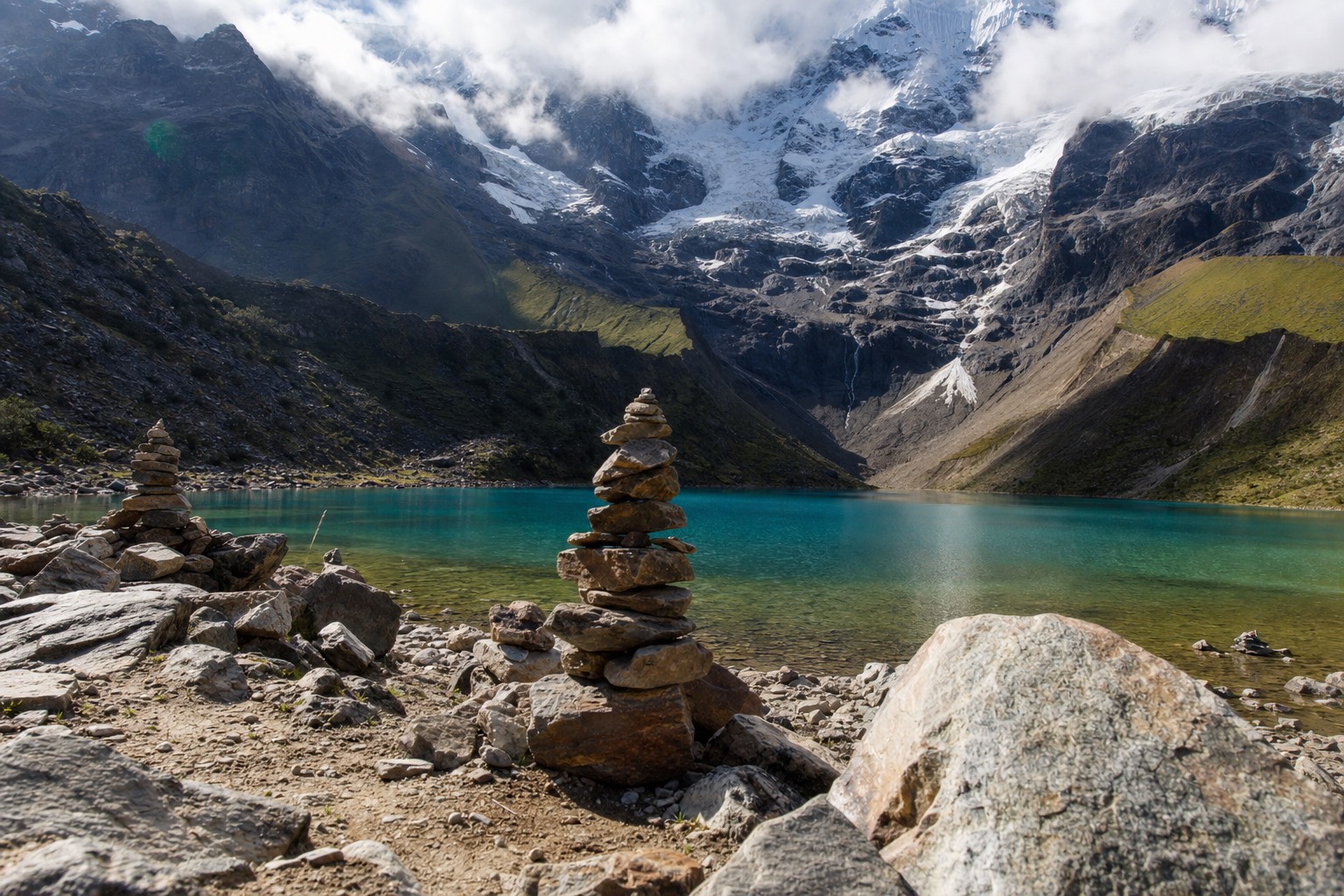
There is a spot on the eastern side of the shore where the stone towers cluster so thickly it looks like a miniature city. Most visitors reach the lake, catch their breath, take the photo, and only then notice them: hundreds of small cairns, some three stones tall, some thirty, a few with coca leaves tucked between the rocks going soft in the wind. Every wet season some collapse and every dry season new ones rise. My grandmother would have called this normal. She talked to mountains her whole life, and up here, that is not a figure of speech.
Booking choice: See the guided lake visit with transport and both meals arranged. Check Humantay Lake dates
Affiliate recommendation · final price and options on GetYourGuide.The mountain you are standing under is a person here
In Andean cosmology the great peaks are Apus, sacred mountain lords who protect the communities living below them, regulate water, and watch over herds and harvests. Humantay is one of them, and its lake is treated as part of the Apu itself. This is a living practice, not a museum memory.
The word Apu comes from Quechua and is usually translated as lord or authority. The tradition predates the Incas, ran straight through them, survived the colonial centuries, and is still active in the villages you drive through on the way from Cusco. Mollepata and the herding families around Soraypampa live in a direct, working relationship with Apu Humantay and with Salkantay, the 6,271 m giant next door whose name is often glossed as wild or untamed mountain. These two peaks are counted among the powerful Apus of the whole Cusco region.
Two peaks preside over this valley, and it is worth knowing which is which before you reach the shore:
| The valley's two Apus | Height | What it carries |
|---|---|---|
| Apu Humantay | ~5,470 m, directly above the lake | The glacier-fed lake is treated as part of this Apu, thanked for the meltwater that feeds the fields |
| Apu Salkantay | 6,271 m, the giant next door | Its name is often glossed as wild or untamed mountain; the dominant peak of the whole valley |
What does a working relationship with a mountain look like? It looks like asking before taking. Water for the fields comes off the glacier, so the glacier is thanked. A herd grazes on the mountain's slopes, so the mountain is acknowledged as the owner of the grass. When something big is coming, a journey, a harvest, an illness in the family, people bring the Apu something first: coca leaves, a small ceremony, sometimes a full despacho with a ritual specialist. The lake, glacier-fed and startlingly coloured, is one of the most charged places to do it.
I am from Cusco, and I want to be straight about my own position. I did not grow up doing despachos every month. Plenty of us in the city are a step removed from the full practice. But I have stood at that shore while a paqo, an Andean ritual specialist, worked through a ceremony for a family from Mollepata, and the tourists thirty metres away had no idea they were watching something that would have looked much the same five hundred years ago.
The coca leaves you will see tucked between the stones
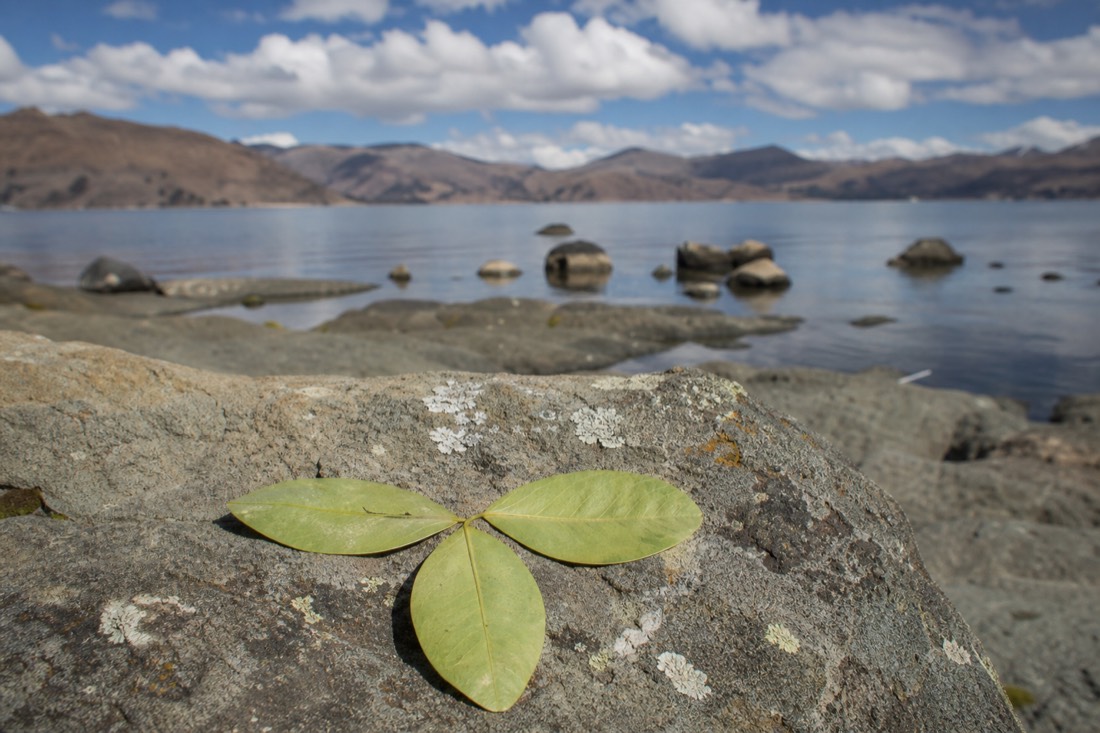
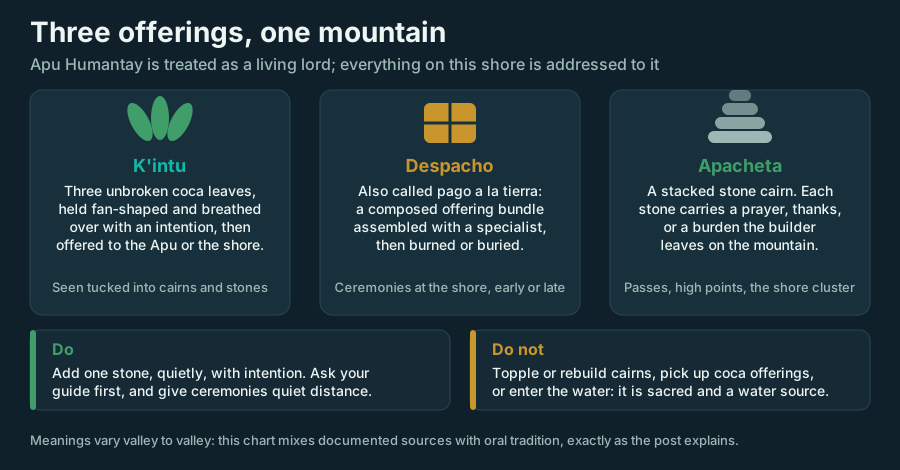
The basic offering is the k'intu: three good coca leaves held together, breathed over with an intention or a prayer, then given to the earth, the Apu, or the lake shore. Larger despacho ceremonies, sometimes called pago a la tierra, bundle coca with other symbolic items as a formal act of thanks.
Coca is the connective tissue of Andean ritual life. The k'intu of three leaves is the everyday grammar of it: you choose unbroken leaves, hold them fan-shaped between your fingers, blow softly across them while naming your intention, and offer them. On the trail you will see k'intus left at the base of cairns, under stones at the pass, and along the shoreline. The bigger form, the despacho or pago a la tierra, is a composed bundle of offerings assembled by a specialist and usually burned or buried. Tour agencies in Cusco offer staged versions of it now, which sits oddly with some people, but the underlying ceremony is entirely real and still performed for entirely practical reasons: gratitude for water, protection for animals, permission for a journey.
Here is the honest layer I owe you, because the brief I set for myself on this site is no invented facts. Some of what I have just described is documented by anthropologists and cultural writers. Some of it, especially the specific meanings families attach to specific gestures, is oral tradition that varies from valley to valley and was taught to me in conversation, not in books. Where those two differ, the valley wins. A guide from Mollepata will tell you things about Apu Humantay that no published source contains, and their version is not less true for being unwritten.
| Offering | What it is | Where you will see it |
|---|---|---|
| K'intu | Three coca leaves with a breathed intention | Tucked into cairns, under shore stones |
| Despacho / pago a la tierra | Composed offering bundle, made with a specialist, burned or buried | Ceremonies at the shore, usually early or late |
| Apacheta | Stacked stone cairn, built stone by stone as a prayer or a released burden | Passes, trail high points, the lakeshore cluster |
| Simple left tokens | A leaf, a flower, occasionally a splash of drink to the earth | Anywhere along the final approach |
What the stone cairns actually mean
An apacheta is a prayer you can pick up. Each stone added to the stack traditionally carries something: a request for protection, thanks for a safe climb, a burden the builder wants to leave on the mountain. They accumulate at passes and sacred points because those are the places where travellers have always paused and asked permission.
The custom is old and wide. Apachetas mark high passes across the whole Andean world, and the logic is consistent: you arrive somewhere that took effort, you acknowledge the power that let you pass, and you add your stone to everyone else's. Some people are handing over a worry. Some are asking for a safe descent. Some are simply saying thank you in the only language the place accepts, which is attention and a small act. Stone by stone, the cairn becomes a record of everyone who stopped and meant it.
At Humantay the cairns concentrate along the shore, which tells you how the lake is understood: as a threshold, the same way a 4,800 m pass is a threshold. When I bring a group up, I explain the cairns before anyone wanders into them, because the difference between that shoreline and a pile of rocks is invisible unless someone tells you. This is also where I put in a word for going with any guided group at all rather than alone: the cultural layer is exactly what you cannot get from the trail itself, and it changes what you think you are looking at. The full comparison of guided versus independent is in the guide on going without a tour.
There is a documented-versus-oral split here too, so let me be precise about it:
| Claim about apachetas | Status |
|---|---|
| Cairns as offerings at passes and sacred sites across the Andes | Documented, long historical record |
| Each stone as a prayer, burden, or request for protection | Documented in general terms; details vary by community, largely oral |
| The Humantay shore cluster having one fixed official meaning | Not documented; treat any single confident story as one family's version |
| Visitors encouraged to ask guides or locals before adding stones | Current published guidance from Cusco-based cultural writers |
What to do, and what not to do, at the shore
Do not dismantle, topple, or rebuild anyone's cairn, and do not enter the water: the lake is sacred to local communities and a protected water source, so swimming and wading are prohibited. Adding your own stone is generally accepted if done quietly and with intention. When unsure, ask your guide.
The don'ts matter more than the dos, so start there. Knocking over an apacheta for a photo, or harvesting its stones to build your own, reads to local people roughly the way rearranging headstones would read to you. It happens every season, almost always from ignorance rather than malice, which is exactly why I am writing this. The water rule is absolute and doubles as conservation: no swimming, no wading, no filling bottles, because this is both a sacred site and the drinking-water source fed by the glacier. I cover the full reasoning in can you swim in the lake, but the short version is that the prohibition is real, posted, and enforced by the community that collects your entrance fee.
Adding a stone is the grey zone people ask about most. My honest answer: the tradition is alive, not fenced off, and a visitor who adds one stone with a moment of actual intention is participating, not trespassing. What lands badly is treatment of the shore as a rock-balancing playground, twenty cairns thrown up for a photo spree, stones pulled from existing stacks. Intention is the whole substance of the act. Without it you are just stacking rocks at someone's altar.
| At the shore | Do | Do not |
|---|---|---|
| Existing cairns | Walk around them, photograph respectfully | Topple, dismantle, or take stones from them |
| Adding a stone | One stone, placed quietly, with intention | Mass-building towers for photos |
| The water | Stay on the shore, enjoy it from the edge | Swim, wade, wash hands, fill bottles |
| Coca offerings | Leave them undisturbed | Pick them up or pose with them |
| Ceremonies in progress | Keep distance, keep quiet | Photograph people close-up without asking |
How guides frame it, and why it changes the day
Most Cusco guides give the Apu talk on the final stretch before the shore, and the good ones frame it as introduction rather than rules: you are about to meet a mountain that local people regard as a living lord, and the cairns are the visible edge of that relationship. Groups that hear this arrive differently.
I have watched it happen too many times to doubt it. A group that gets the context walks the last hundred metres quieter. They notice the coca leaves. They ask better questions, and someone almost always asks whether they may add a stone, which is exactly the right question because it treats the shore as belonging to someone. On a shore like this, the guide is not a luxury. The guide is the translator.
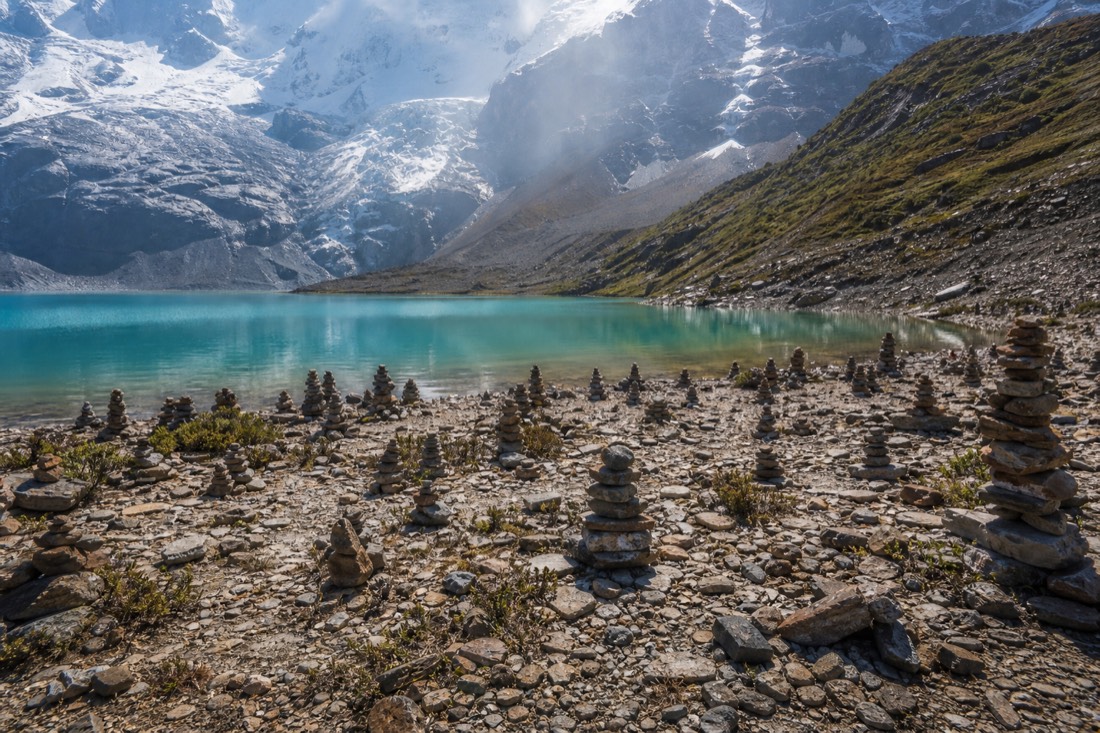
The last time I was up there, an older man from Mollepata was rebuilding a cairn the winter had taken down. Not his own, he told me. He did not know whose it was. It had fallen, so he was putting it back, the way you would straighten a neighbour's gate. That is the whole tradition in one gesture: the shore belongs to the mountain, and everyone who understands that helps keep it standing.
Your next step
Choose your day from Cusco
Match the trip to your plans
General recommendation · confirm your own requirements
Humantay Lake with breakfast and buffet lunch
Have a date in mind? Let one booking cover the ride to Soraypampa, your guide and both meals. Check your departure before arranging the rest of your trip.
12–13.5 hours · Transport, English/Spanish guide, breakfast and buffet lunch, first aid and emergency oxygen. Entrance fee and optional horse are extra, paid locally in cash.
Choose the historic-center pickup option and confirm your hotel; other options use a meeting point. Downtown Cusco drop-off.
A steep high-altitude hike. Not suitable for pregnancy, mobility or respiratory limitations, vertigo or low fitness. A horse does not remove the walking or altitude requirements. Free cancellation until 24 hours before departure.
Affiliate links: we may earn a commission if you book, at no extra cost to you.